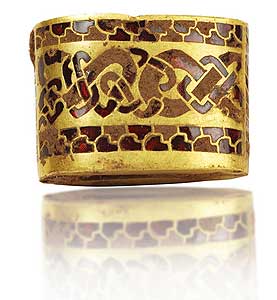
Gold inlaid with garnets, from the Staffordshire Hoard.
Before beginning today’s podcast, I need to explain a few words. The first word is “treasure”. Treasure means things which are very valuable; generally, “treasure” means things made of gold or silver or precious stones. The second word is “hoard”. If someone collects a lot of valuable things, and then hides them or keeps them secret, we call that a “hoard”. And finally, a “find” is of course something which you find – but normally it means something very special or unusual or valuable which you find. But that’s enough vocabulary practice. On with today’s podcast. Terry Herbert is 55 years old. He lives in a small town called Bloxwich, about 16 kilometers north-west of Birmingham. His hobby is metal-detecting. A metal-detector is a tool which tells you when there is metal in the ground. You move the metal detector slowly over the ground, and it goes ‘bleep’ if it finds anything made of metal. In July this year, Terry went metal-detecting in a field in Staffordshire owned by a friend of his, and found something completely amazing. He discovered a large number of gold and silver objects. He told the authorities what he had found, and a team of archaeologists then explored the site carefully and found more objects. When they started to clean and examine the discovery, they realised that Terry Herbert had found over 1500 objects dating from about 700AD. It was the largest hoard of Anglo-Saxon treasure ever found in England. The Anglo-Saxons were people who invaded and settled in England as the Roman Empire collapsed in about the 4th century. They came from northern Germany and the language which they spoke – which we call Anglo-Saxon or Old English – was the ancestor of modern English. They were skilled metal craftsmen; they made delicate and intricate designs on gold and silver, and often inlaid the metal with precious stones, such as garnet, which is a dark red stone. After they arrived here, the Anglo-Saxons divided England into a number of kingdoms and spent most of the next several hundred years fighting each other, and the Danes and the Scots. The largest and most powerful of the Anglo-Saxon kingdoms was called Mercia. It covered all of central England, including the area where the Staffordshire Hoard was found.
Gold inlaid with garnets, from the Staffordshire Hoard.