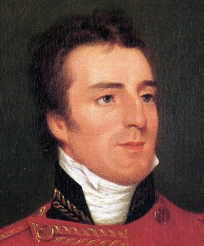
 Today we are going to meet the Duke of Wellington, and talk about the word “contemporary”.
In fact, both the Duke of Wellington and the word “contemporary” were in the podcasts about Glastonbury. You can’t remember the Duke of Wellington? Was he perhaps one of the pop singers at Glastonbury? No, he wasn’t. But you remember that, because of the mud at Glastonbury, many festival-goers wore wellington boots. Wellington boots are waterproof boots made of rubber. In America, people say “gumboots”. In Britain we often say “wellies”. And the name “wellington boot” comes from the Duke of Wellington, who was the first person to make this type of boot popular.
In 1815, the Duke of Wellington was the commander of the British army at the Battle of Waterloo, which is a place just outside Brussels in Belgium. At Waterloo, Wellington and his allies defeated the French army led by Napoleon Bonaparte. Later, Wellington became Prime Minister of Britain for a short time. He persuaded Parliament to pass laws to give rights to Catholics in Britain, for the first time in 200 years. But in all other respects, he was deeply conservative. He opposed any other sort of political reform. The London mob gathered regularly outside his home to shout slogans and throw stones at the windows.
 So, you now know something about the Duke of Wellington. Let’s meet the word “contemporary”. Contemporary means “belonging to the same time”. If we are talking about the Duke of Wellington, “contemporary events” means things that happened during his life – things like the revolution in France, and the rise to power of Napoleon; or the industrial revolution; or the movement for political reform in Britain, which Wellington opposed. “Contemporary newspapers” means newspapers from that time – the newspapers which reported the victory at Waterloo, for example, or the riots and demonstrations in London for political reform. We can say that Wellington and Napoleon were contemporaries – they lived at the same time; in fact, they were born in the same year, in 1769. On the website and, I hope, on your iPod screens there are pictures of both Wellington and Napoleon. They are wearing contemporary dress, or contemporary fashions; that means, the sorts of clothes that important people wore at that time.
But often in English we use the word “contemporary” to mean “belonging to the present time”, in other words to mean “modern”. We talk about contemporary art or contemporary music or contemporary fashions or contemporary furniture. We mean modern music, modern art etc – music or art of the 21st century. You remember that, in the last podcast, Hilary talked about contemporary bands that played at Glastonbury. She meant modern bands, bands that young people today like to listen to.
So, contemporary is a word that can mean different things depending on its context, that is, depending on what you are talking about. If you are talking about Wellington, it means “of the early 19th century”. If you are talking about the Beatles, contemporary means “of the 1960s”. And if you are talking about today, contemporary means very modern, or up-to-date.